Bedding · A Caregiver’s Guide
A Practical Guide to Organic Crib Sleep Surfaces
Choosing a crib mattress is an exercise in balancing material preferences with practical essentials: a firm, flat surface, a close fit in the crib, and care instructions you can follow. Organic fibers and independent certifications can help you understand how a product is made—but they do not replace safe-sleep guidance or careful attention to construction.
A thoughtful approach starts with the mattress, then considers whether a simple washable pad can protect it without adding softness, looseness, or complexity to the sleep setup.
There is a particular intimacy to preparing a baby’s sleep space. The crib may be among the smallest pieces of furniture in the home, yet it invites unusually careful consideration: what lies beneath the fitted sheet, how the surface will be cleaned, and whether each layer belongs there at all. For families drawn to organic materials, these questions often lead to a closer look at cotton, wool, latex, manufacturing practices, and certification labels.
That interest is understandable. A material’s origin and treatment can matter to caregivers, especially when a product will be used every day. But an organic claim is only one part of the decision. For an infant sleep surface, fit, firmness, flatness, and compatibility with the crib are central practical considerations. A beautiful fiber story has little value if the mattress does not fit securely or if an added layer changes the intended surface.
This guide explains how to assess organic crib mattress materials, what certifications can—and cannot—tell you, how to think about a washable crib mattress pad, and why care labels deserve a place in the buying decision. It is an educational resource, not a substitute for current safe-sleep advice from your pediatrician or public-health authorities. Always follow the crib and mattress manufacturers’ instructions and current recommendations from trusted health sources.
Begin with the sleep surface, not the label
“Organic” describes aspects of how certain materials are grown or processed under a defined standard. It does not, by itself, describe a mattress’s firmness, shape, dimensions, structural integrity, or suitability for a particular crib. These details deserve to come first. Before comparing fibers or certification marks, confirm that the mattress is intended for the crib in question and that the finished product follows the manufacturer’s specifications.
A mattress should sit securely within the crib, without a gap that could create a hazard. Check the mattress and crib documentation for compatible dimensions and fit guidance, and inspect the setup after placing the mattress in the frame. A well-fitting surface should not shift freely or leave conspicuous spaces along the sides. If the crib or mattress has been assembled, adjusted, or moved, take a moment to confirm the fit again.
Firmness and flatness matter too. An infant sleep surface should not be made softer by a thick topper, cushioned insert, pillow, or other product not specifically intended and permitted for that use. Decorative styling, a plush hand-feel, or an adult’s preference for a softer bed should not determine an infant’s setup. Keep the sleep space simple, and consult current safe-sleep guidance for what should—and should not—be placed in the crib.
These practical checks are not in competition with material preferences. They establish the foundation on which those preferences can be considered. Once fit and construction are clear, caregivers can compare the mattress’s stated materials, certifications, maintenance requirements, and expected use.
What organic crib mattress materials may include
Crib mattresses can use different combinations of core, padding, cover, and finishing materials. Product descriptions may name cotton, wool, latex, or other components, but the exact role of each layer matters. Read the construction details rather than relying on a broad phrase such as “natural” or “organic.” If information is missing, ask the maker to clarify what is in the core, what forms the outer cover, and whether any components are removable.
Cotton
Cotton may appear in a mattress cover or in a separate pad. Its feel and performance depend on the weave, weight, finishing, and construction. A cotton cover is not automatically proof that every component is organic, so check which parts are covered by any stated certification.
Wool
Wool may be used as filling or as part of a mattress’s layered construction. Product information should explain its position and care requirements. Do not assume that a material’s natural origin means the finished product needs no maintenance or has a particular performance characteristic; consult the maker’s specifications.
Latex
Latex may form some or all of a mattress core, depending on the design. Ask whether the description refers to a specific latex type, whether it is certified, and how it is incorporated into the mattress. Material names alone do not establish the finished surface’s fit or suitability.
Layered constructions
A mattress may combine multiple materials, each serving a different purpose. Seek a clear component list and an explanation of the construction. The more precisely a maker describes materials and processing, the easier it is to evaluate the product against your priorities.
Material preference is personal, but the language used to describe materials can be imprecise. Terms such as “natural,” “eco-friendly,” and “chemical-free” may not have the same meaning from one label to another. Instead of treating them as guarantees, look for specific, verifiable information: named fibers, the parts of the product covered, a certification’s scope, and clear care instructions.
Understanding GOTS and other certification claims
Certifications can make material claims easier to evaluate, but only when you understand what is being certified. GOTS, the Global Organic Textile Standard, is associated with organic textile processing and labeling. A GOTS claim should be checked in context: does it apply to the finished textile product, a particular component, or the raw fiber? Look for a clear certification statement and, where available, details that identify the scope of the claim.
Certification is not a substitute for reading the full product description. A mattress may contain several materials, and a certification associated with its cover does not necessarily establish that every layer has the same status. Ask which components are included and whether the product’s claim applies to the item as sold. Credible product information should make this distinction understandable rather than leaving caregivers to infer it from a logo.
It is also useful to separate material standards from safety and performance questions. A textile certification does not necessarily tell you whether a mattress fits your crib, how firm it is, how it was tested for structural performance, or whether an added layer is appropriate. Treat these as separate checks. Review manufacturer documentation, consult the crib instructions, and follow current infant safe-sleep recommendations.
For an organic crib mattress, a measured approach is more useful than chasing an ever-longer list of labels. Decide which material and processing concerns matter most to your household. Then verify the claims, compare the complete construction, and make sure the basic dimensions and care requirements work in everyday life.
Fit: the detail that should never be an afterthought
Crib mattresses are commonly described by standard size, but labels are not a substitute for checking the actual crib and mattress combination. A mattress that is too small, too large, or otherwise incompatible can undermine a carefully chosen sleep setup. Consult the instructions for both products and follow any fit-check method provided by their manufacturers.
Before use, place the mattress in the crib and examine the perimeter. Confirm that it lies flat and that the edges meet the sides as intended. The fitted sheet should be designed for the mattress dimensions and should stay securely in place. Avoid improvising with extra fabric, folded blankets, or layered bedding to compensate for a poor fit. If the mattress appears damaged, warped, or incompatible, contact the manufacturer rather than trying to alter it.
Fit also applies to any washable pad. A pad should be designed for crib use and should not bunch, slide, or create raised edges. Confirm its dimensions, construction, and intended placement, then check that it remains smooth beneath the fitted sheet. If it interferes with the mattress fit or makes the sleep surface uneven, do not use it in that configuration.
These checks are especially worth repeating after washing. Cotton textiles may change dimensions with laundering, and a freshly cleaned pad may sit differently than it did before. Follow the care label, allow the item to dry fully, and verify that it still lies flat and fits as intended before placing it back in the crib.
What a washable crib mattress pad does
A crib mattress pad is an optional layer placed over the mattress and beneath the fitted sheet. Its everyday role is practical: it can provide a washable surface between the mattress and common messes such as spills, sweat, or skin oils. That may make routine cleaning more manageable, but a pad does not replace the mattress, the fitted sheet, or safe-sleep guidance. It should not be treated as a cushion or a way to soften the underlying surface.
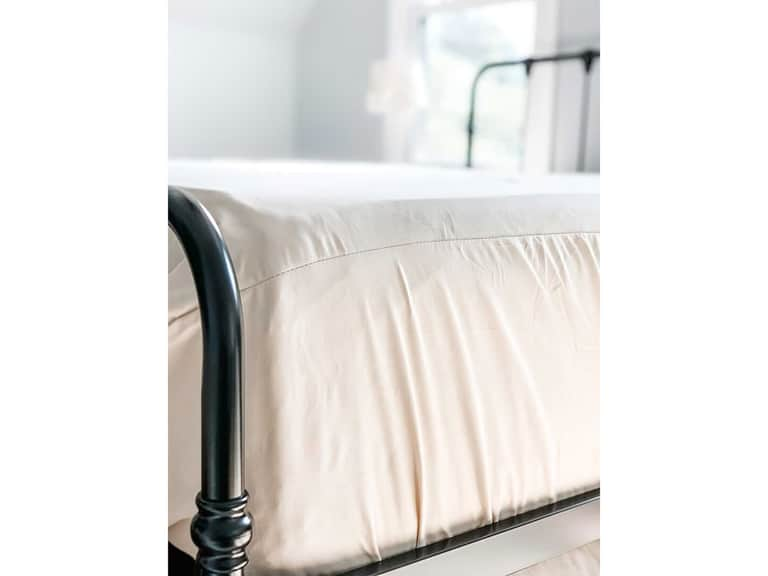
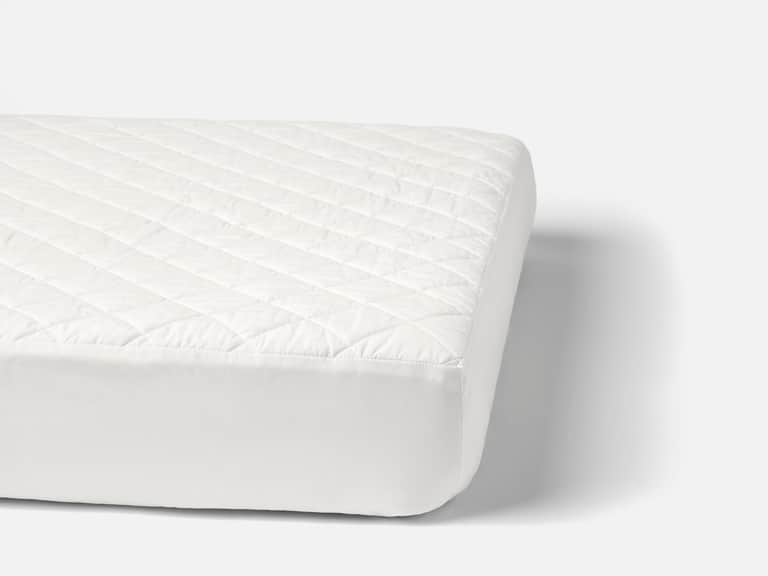
For caregivers who prefer organic textiles, the Organic Crib Mattress Pad is made from 100% organic cotton and has a 220 percale covering with two-inch quilted squares. It is described as GOTS certified and is designed to sit between the crib mattress and fitted sheet. Its stated dimensions are 28 by 52 inches, with an 8-inch depth, and the product description identifies it as a washable layer for helping protect the mattress from everyday spills, stains, sweat, and skin oils.
Those details are a starting point, not a reason to skip a fit check. Compare the pad’s dimensions with the mattress, follow the manufacturer’s placement instructions, and ensure the finished setup remains flat and secure. A quilted construction may feel different from a plain textile, so pay attention to its thickness and surface. The purpose is protection, not added plushness.
Some caregivers may instead be considering a waterproof protector. These products differ in construction and care from a simple cotton pad, and their fit and surface characteristics should be assessed on their own terms. Do not assume all protectors are interchangeable or that a product intended for an adult mattress is suitable for a crib. Check the specific item’s intended use and manufacturer guidance.
Choosing a pad without complicating the setup
Keep the decision focused. A useful crib pad should have clearly stated dimensions, an understandable material description, and care instructions that are practical for your household. It should stay smooth under the fitted sheet and should not change the mattress’s intended flat, firm character. If the product description is vague about use, construction, or fit, seek clarification before purchasing.
- Confirm intended use. Look for explicit information that the pad is designed for a crib mattress, rather than relying on a generic bedding description.
- Compare dimensions. Check the pad against the mattress and the product’s stated fit guidance. Do not force an item that is too small or too large.
- Assess the surface. Make sure the pad lies flat and does not bunch, shift, or create pronounced ridges beneath the sheet.
- Read the material claims carefully. Identify which fibers are used and what any certification applies to.
- Choose care you can maintain. Consider wash temperature, drying method, and whether the item needs special handling.
- Recheck after laundering. Once clean and dry, confirm the pad still fits and lies smoothly before reuse.
More layers are not automatically better. In a crib, simplicity is a practical virtue. Use only products intended for the sleep space, keep the mattress setup aligned with current safety guidance, and avoid adding toppers or other cushioning to compensate for a mattress whose feel does not meet an adult’s preferences.
Care instructions are part of the purchase
Care labels reveal how a product is expected to be maintained, and they can help prevent avoidable wear. Before buying, note whether the item is machine washable, which cycle and water temperature are recommended, and how it should be dried. These details can matter as much as the initial fabric choice, particularly for a layer intended to be washed regularly.
For the Organic Crib Mattress Pad, the listed care directions call for a cold, gentle machine wash with like colors and tumble drying on low. The instructions also say to remove it promptly and note that warm ironing is optional. Follow the product’s current label and maker guidance, since care directions should take precedence over general advice.
Do not assume that a mattress itself can be washed just because its pad is washable. Mattress cores and covers may have different care requirements; some are designed for spot cleaning only, and some covers are not removable. Avoid soaking or applying cleaning products unless the mattress manufacturer specifically permits it. Let any cleaned surface dry fully before returning it to use, and contact the maker if you are uncertain about a stain or spill.
Routine inspection is simple but useful. Look for seams that have opened, fabric that has torn, changes in shape, or signs that a pad no longer stays in place. Replace a damaged accessory rather than continuing to use it in a way that might affect the smoothness or fit of the sleep surface.
Questions to ask before buying
A concise list of questions can turn a dense product page into a more useful comparison. If the answer is not stated clearly, contact the manufacturer or retailer and ask for written clarification.
- What materials are used in the mattress core, cover, and any other layers?
- Which components are covered by the stated organic or textile certification?
- What are the finished mattress dimensions, and which crib models or dimensions is it designed to fit?
- How should the mattress and any pad be cleaned and dried?
- Is the pad specifically intended for crib use, and how should it fit beneath the fitted sheet?
- Does the mattress have a removable cover, and what does the manufacturer say about washing it?
- Where can the full product instructions, certification information, and warranty terms be reviewed?
A clear answer should distinguish between what a product is made of, what a certificate verifies, and how the product should be used. That distinction makes it easier to compare options without leaning on vague claims or assuming that one appealing feature answers every question.
Common assumptions worth revisiting
“Organic” means the whole mattress is certified
A claim may apply to a particular textile or component rather than every part of a finished mattress. Check the scope and wording instead of assuming that all layers share the same certification.
A pad is just a harmless extra layer
Any layer should be assessed for its intended use, fit, thickness, and effect on the surface. Optional accessories still need to be compatible with the crib mattress and used according to their instructions.
Natural materials need no special care
Natural fibers can have specific washing and drying requirements. Heat, bleach, or improper cleaning may damage textiles or change how they fit. Follow the maker’s care directions.
A familiar size guarantees a secure fit
Size labels are useful, but the actual crib and mattress pairing must still be checked. Confirm compatibility using the manufacturers’ specifications and inspect the assembled setup.
A calm, practical buying checklist
Before deciding on an organic crib mattress or a protective layer, use this short sequence. It keeps the most consequential questions visible while leaving room for personal material priorities.
- Verify compatibility: match the mattress to the crib using both manufacturers’ instructions.
- Check the construction: identify the core and cover materials, and look for specific rather than sweeping claims.
- Review certification scope: determine which materials or components a certification covers.
- Prioritize the surface: maintain a firm, flat, secure setup and follow current infant safe-sleep guidance.
- Evaluate accessories separately: confirm any pad is intended for crib use and fits smoothly beneath the fitted sheet.
- Read the care label: understand washing, drying, and spot-cleaning requirements before the first use.
- Inspect regularly: check for damage, shifting, or changes in fit, especially after laundering.
The considered choice
An organic crib sleep surface is best evaluated through a combination of practical checks and informed material choices. Start with the mattress’s fit, firmness, flatness, and compatibility with the crib. Then examine the construction, verify what certifications actually cover, and choose care routines that suit the product’s instructions.
A washable cotton crib pad can be a useful protective layer when it is designed for the mattress, fits smoothly, and does not compromise the intended setup. Its appeal lies in a simple function: a removable textile that can be laundered according to its care label. The mattress remains the foundation, and the sleep space should remain uncomplicated.
Thoughtful preparation need not mean adding more. Often, the most reassuring approach is the clearest one: a well-fitting mattress, an accurately described material story, a correctly sized fitted sheet, and only those accessories that are appropriate for the crib. When questions remain, use manufacturer instructions and current pediatric safe-sleep recommendations as the final guide.
Frequently asked questions
Does an organic label tell me whether a crib mattress is safe for my crib?
An organic claim concerns materials or processing under a particular standard; it does not confirm compatibility with a specific crib. Check dimensions, fit, construction, and manufacturer guidance separately, and follow current safe-sleep recommendations.
What does GOTS certification mean for crib bedding?
GOTS is a standard associated with organic textile processing and labeling. Read the product’s certification details to understand which components are covered. A certification claim should not be assumed to apply to every part of a multi-material product.
Can a crib mattress pad protect the mattress?
A washable pad can help shield a mattress from everyday spills and wear, provided it is intended for crib use, fits correctly, and stays smooth beneath the fitted sheet. It should not be used to add cushioning or alter the sleep surface.
How should an organic cotton crib pad be washed?
Care varies by product. Follow the specific label rather than a general rule. For the Organic Crib Mattress Pad described in this guide, the listed directions are a cold, gentle wash with like colors and low-heat tumble drying, with prompt removal.